How to Check New Prescription Lenses Before You Accept Your Glasses
A new pair of glasses can look perfect and still need a small adjustment. Before accepting new lenses, take a few minutes to check how they sit, whether you can see comfortably and whether the supplied lenses match what you ordered. You do not need specialist equipment to spot a loose frame, distracting scratch or…
By Viszy · · 4 min read
In this article
- Start with the order, not the mirror
- Look at the lenses under ordinary light
- Check how the frame sits on your face
- Test the distances you actually use
- Ask for lens power and fitting verification
- Do not confuse adaptation with a defect
- Your five-minute handover checklist
- Frequently asked questions
- The bottom line
A new pair of glasses can look perfect and still need a small adjustment. Before accepting new lenses, take a few minutes to check how they sit, whether you can see comfortably and whether the supplied lenses match what you ordered. You do not need specialist equipment to spot a loose frame, distracting scratch or obvious fitting problem. But you should leave power and optical-centre verification to the optical professional, who has the instruments and measurements to confirm them.
Start with the order, not the mirror
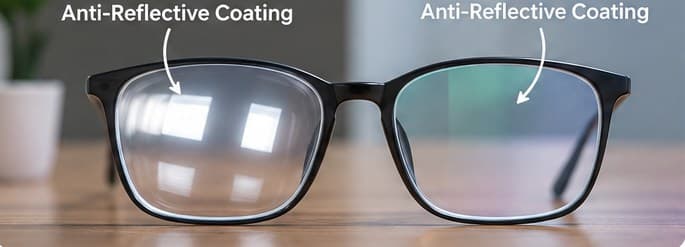
Check that the frame model or your own frame is correct and that the lens type matches your order: single vision, progressive, bifocal or another design. Review requested features such as tint, polarization, photochromic behaviour and coatings. A clear lens with anti-reflective coating can still show subtle coloured reflections; this alone does not demonstrate a defect. If you are receiving replacement lenses for an existing frame, ask whether your old lenses have been returned if you wanted to keep them. Resolve missing features before leaving.
Look at the lenses under ordinary light
Hold the spectacles by the frame and look across each lens for obvious scratches, chips, smudges, coating flaws or dirt. Clean off fingerprints before deciding a mark is a flaw. Check that the lens edges sit neatly inside the rim, with no visible gap or unusual stress near the mount. A lens should not rattle when the frame is moved gently. Do not press on the lens or bend the rim to test security. If something looks wrong, show the optician rather than attempting a repair.
Check how the frame sits on your face
Put the glasses on in your normal posture, without pushing them high or low to make the view clearer. Both lenses should sit at a comfortable height and the temples should not squeeze your head. The bridge should be stable without digging into the skin, and the glasses should not slide down every time you look at a page. Look straight ahead in a mirror: a tilted frame can be a straightforward fitting issue. Ask for professional adjustments before judging the lens optics.
Test the distances you actually use
For distance glasses, look at a sign across the room and then at a more distant object if safe. For reading glasses, hold text at your normal working distance. For progressives, test distance, an intermediate task such as a laptop and near reading using the intended portions of the lens. Try the tasks with both eyes open, then note if either eye seems unusually different. Testing at comfortable, realistic distances gives a better impression than forcing the frame into unnatural positions.
Ask for lens power and fitting verification
An optician can use a lensmeter to check the prescription values in the finished lenses and confirm relevant details such as cylinder axis, prism and near addition where ordered. They can also assess pupillary alignment, fitting height and lens orientation. This matters particularly for progressive or higher-prescription lenses. A correct lens power does not automatically prove ideal fit, and a good fit does not guarantee the prescription was entered correctly. Both are worth checking if vision feels off.
Do not confuse adaptation with a defect
Some new prescriptions feel unusual for a short time, especially when astigmatism correction changes or when you move to progressive lenses. Mild, improving unfamiliarity can be normal, but persistent blur, marked imbalance, double vision or strong discomfort should prompt a review. If you find yourself raising the frame or tilting your head just to see clearly, demonstrate that to the optician; it can point to an alignment or lens-design issue. Avoid driving until you can see reliably and comfortably.
Your five-minute handover checklist
Confirm the order and included coatings; inspect the lenses and frame; check for stable, comfortable fit; test the viewing distances you ordered; and ask what adjustments or rechecks are available if something does not feel right at home. Keep a copy of the prescription and receipt, and ask about the provider’s lens-remake or fitting policy. If you rely on the glasses daily, ask whether you should keep a usable backup pair during any remake.
Frequently asked questions
Can I verify power by looking through the lenses?
Not reliably. A lensmeter is needed for accurate verification.
Should my progressive lenses be clear everywhere?
Progressive designs have different viewing zones and some peripheral blur. The useful zones must still suit your needs.
What if I notice a scratch at home?
Report it promptly and follow the provider’s inspection or returns process.
The bottom line
A good handover combines a simple personal inspection with professional checks. You can confirm comfort, obvious condition and the activities you need to see. Your optician can verify the optical details. Taking both steps gives you the best chance of receiving glasses that are not just newly made, but genuinely right for you.
Need new lenses for your frame?
Free doorstep pickup & drop in 200+ cities. Lenses from ₹800.
Viszy
Viszy's team of lens specialists. We fit and power-check every pair we send out, and write these guides to help you choose with confidence.
Last updated 10 Nov 2026