High-index lenses: 1.56 vs 1.61 vs 1.67 vs 1.74
Thick lenses because of high power? Here’s what lens index means, the difference between 1.56, 1.61, 1.67 and 1.74 lenses, and which index suits your eye power.
By Viszy · · 3 min read
In this article
If your eye power is high, you’ve probably seen lenses that look thick at the edges or make your eyes look small. The fix is a higher-index lens. Here’s what those numbers on the price card (1.56, 1.61, 1.67, 1.74) actually mean, and which one you need.
What is lens index?
Index (refractive index) is a measure of how strongly a material bends light. The higher the index, the more it bends light, so the lens can be made thinner and flatter for the same power.
- 1.50: standard plastic (CR-39). Thickest, but very clear optics.
- 1.56: mid-index. A little thinner, and the most common everyday lens.
- 1.59: polycarbonate. Thin, light and very impact-resistant, popular for kids and sports.
- 1.61: high-index. Noticeably thinner and lighter for moderate powers.
- 1.67: higher-index. For strong powers.
- 1.74: the thinnest commonly available plastic lens, for very high powers.
Which index do you need?
This is a general guide based on your SPH (sphere) power. Your cylinder power and frame size matter too.
| Your power (SPH) | Suggested index |
|---|---|
| Up to ±2.00 | 1.50 or 1.56 |
| ±2.25 to ±4.00 | 1.56 or 1.61 |
| ±4.25 to ±6.00 | 1.61 or 1.67 |
| Above ±6.00 | 1.67 or 1.74 |
For low powers, paying for 1.67 or 1.74 makes almost no visible difference. For a -7.00 prescription, it’s the difference between a lens that looks like a bottle bottom and one that looks normal. Not sure what your numbers mean? Read how to read your eye prescription and what -1 or -2 power means.
Minus power vs plus power
- Minus lenses (short-sight, myopia) are thin in the centre and thick at the edges. A higher index reduces that edge thickness, and a smaller frame helps even more.
- Plus lenses (long-sight, hypermetropia) are thick in the centre and can make eyes look magnified. A higher index flattens them. See plus power explained.
The trade-offs
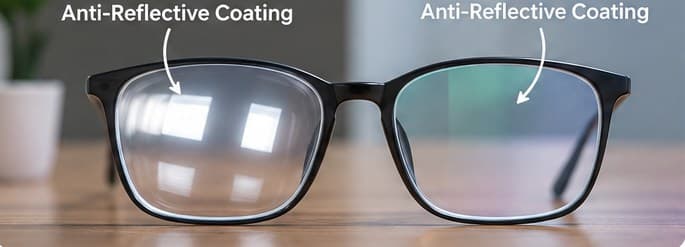
- Reflections: higher-index materials reflect more light, so anti-glare isn’t optional. Every Viszy single vision lens comes with anti-glare and blue-cut included.
- Colour fringes: very high-index lenses can show faint colour fringes at the edges when you look sideways. Most people never notice.
- Price: each step up in index costs more, which is why it only makes sense when your power needs it.
Frame tips for high power
- Choose a smaller, rounder lens shape. Less lens width means thinner edges.
- Full-rim frames hide edge thickness better than half-rim or rimless.
- Thicker acetate frames hide edges better than thin metal ones. See our frame materials guide.
- Get the size right with our frame size guide, so your eyes sit near the centre of each lens.
How Viszy picks the index
You don’t have to choose the index yourself. When you order single vision lenses or replace the lenses in your own frame, our opticians look at your prescription and frame and suggest a thinner index when your power calls for it.
Read next: Best spectacle lenses in India · Anti-glare vs blue-cut · Lens replacement price in India
Need new lenses for your frame?
Free doorstep pickup & drop in 200+ cities. Lenses from ₹800.
Viszy
Viszy's team of lens specialists. We fit and power-check every pair we send out, and write these guides to help you choose with confidence.
Last updated 28 Nov 2026